
If you are a team leader who wants to set performance objectives, how do you define what successful outcomes will look like? Defining performance is not easy – but it’s important to know whether your teams are performing or not.
If you look to Google to define what performance is, you’ll find many results but little clarity. The same goes for academic papers, the one thing they agree on is that there is no agreed definition! When researching our latest book, ‘Rest. Practise. Perform.’ we found that the world of elite sports offered better clarity on what performance really is.
In this article we’ll help you think differently about what performance means so that you and your teams can be better organised to achieve your goals.
Defining performance – the elite sports ‘performance window’
In elite sports, performance is very clearly defined, it is the race, match or competition itself. This is what we call the ‘performance window’ – the period of time when someone works in an intense and focused way to achieve maximum results. What’s more, there’s a clear directional measure, showing signs of progression. They consider the overall goal, not just the win or loss experienced in each game.
What does performance mean for you?
If you are finding it hard to define, you are not alone. So accustomed are we to ‘work hard’ all the time, that we rarely get the time to give thought to the behaviours and activities we actually need to deliver the performance we want. In ‘Rest. Practise. Perform.’ we translate the learnings from elite sports and apply them practically into organisations. Looking at the dictionary definition – ‘performance’ is simply the ability to perform a function or task. In a team context, everyone has a role – and often a specific one. An F1 pit team is a very good example with a very critical performance window. That’s why you also need to be clear on what each person in that team – or area of the organisation – needs to do to support that performance.
As well as individual roles, you’ll also need clarity on what you want your team to focus on. For example, performing over time (delivering a service) is different from performing at a peak time in the year or the ability to deliver a project on time and to budget. Once you are clear on your point of difference, it can help redefine what you need in terms of performance measures and activity. All of which leads to that all important outcome.
Leading your team to your performance outcome
Are the tasks and activities you are performing leading you to where you want to be? There are many distractions that can feel like they are contributing towards performance but are really just rearranging the deckchairs, like constant reorganisations or your manager’s pet project.
That’s why defining your outcome is the first step towards helping your team to become performance focused. A ‘company mission’ risks being too vague so we suggest translating this into a team or individual context so people feel connected, engaged and they know what performance means to them.
Here are some tips to define solid outcomes for you and your team:
Be clear on your purpose: Clarity here helps you understand what performance is for you and your team and how to measure it. One tactic that can really help is creating a more relevant ‘internal purpose statement’. Can you describe very clearly exactly what your team does and how that relates to your company’s purpose? For example, in a tech organisation your teams’ role might be ‘we make sure that every release goes out bug free’. Internal mission statements are not sexy or inspirational, but they keep people anchored to what’s important about what you do.
Know your part in the outcome: Make this as specific as possible. It’s easier to be general but that’s less helpful. Starting with a simple ‘We do X because of Y’ can be useful because it connects what you do to the why, the purpose. You can then frame these on individual roles – such as, to use the tech example, ‘I run multiple challenging system tests to try and catch any bugs as early as possible’.
Know when you need to perform: Elite sports have their clear performance window, but you can use the analogy to help you and your team to better focus on the key moments that count. This will also help move you away from the danger of falling into the ‘we need to perform all the time’ belief. Look at the flow of your week, month and year. What are the key moments in each of these? It will help you better identify when you need to be most focused – and perhaps those things that aren’t as important as you thought.
In conclusion
Organisations have long struggled to define what performance means to them or how to measure it. That contrasts with the world of elite sports where the ‘performance window’ is very clearly defined. For teams and their leaders, better defining your own performance window would lead to better clarity on what you are expected to do and help realise the results you want to achieve.
Out Now: ‘Rest. Practise. Perform.’
‘Rest. Practise. Perform.’ can teach you valuable tips on sustainable wellbeing and performance, based on the strategies used in elite sports. In their new book, Karen Meager and John McLachlan draw from extensive research and their deep understanding of leadership behaviours to provide you with a playbook for adopting elite sports’ winning techniques.
To download the first chapter for free please visit the ‘Rest. Practise. Perform.’ Page on our website.
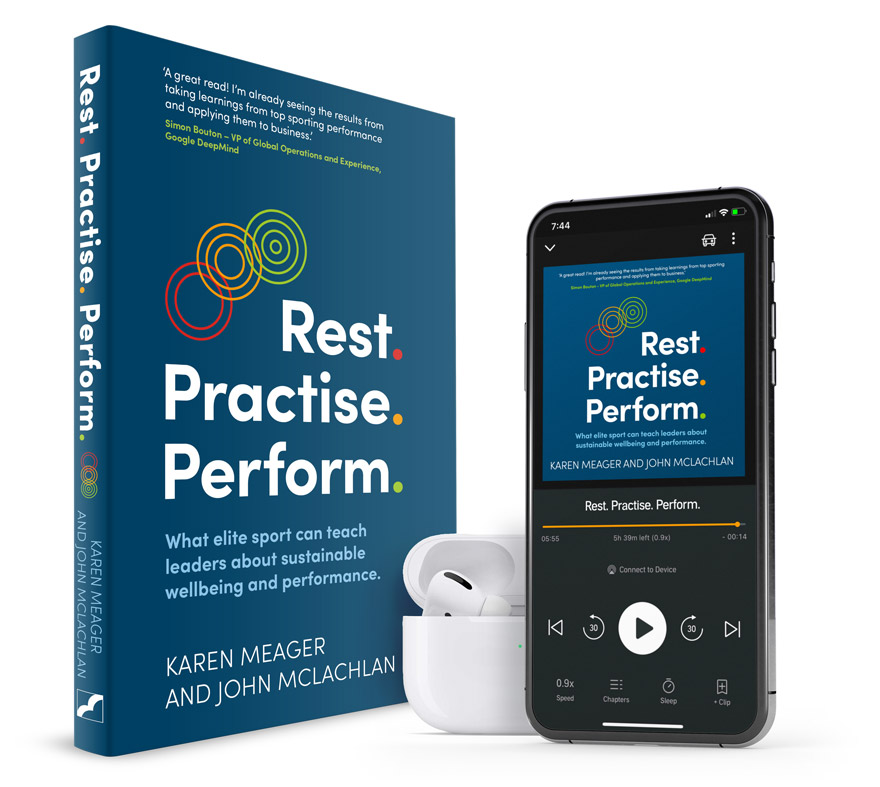
Available to order via Amazon here, and also in audio format, here.