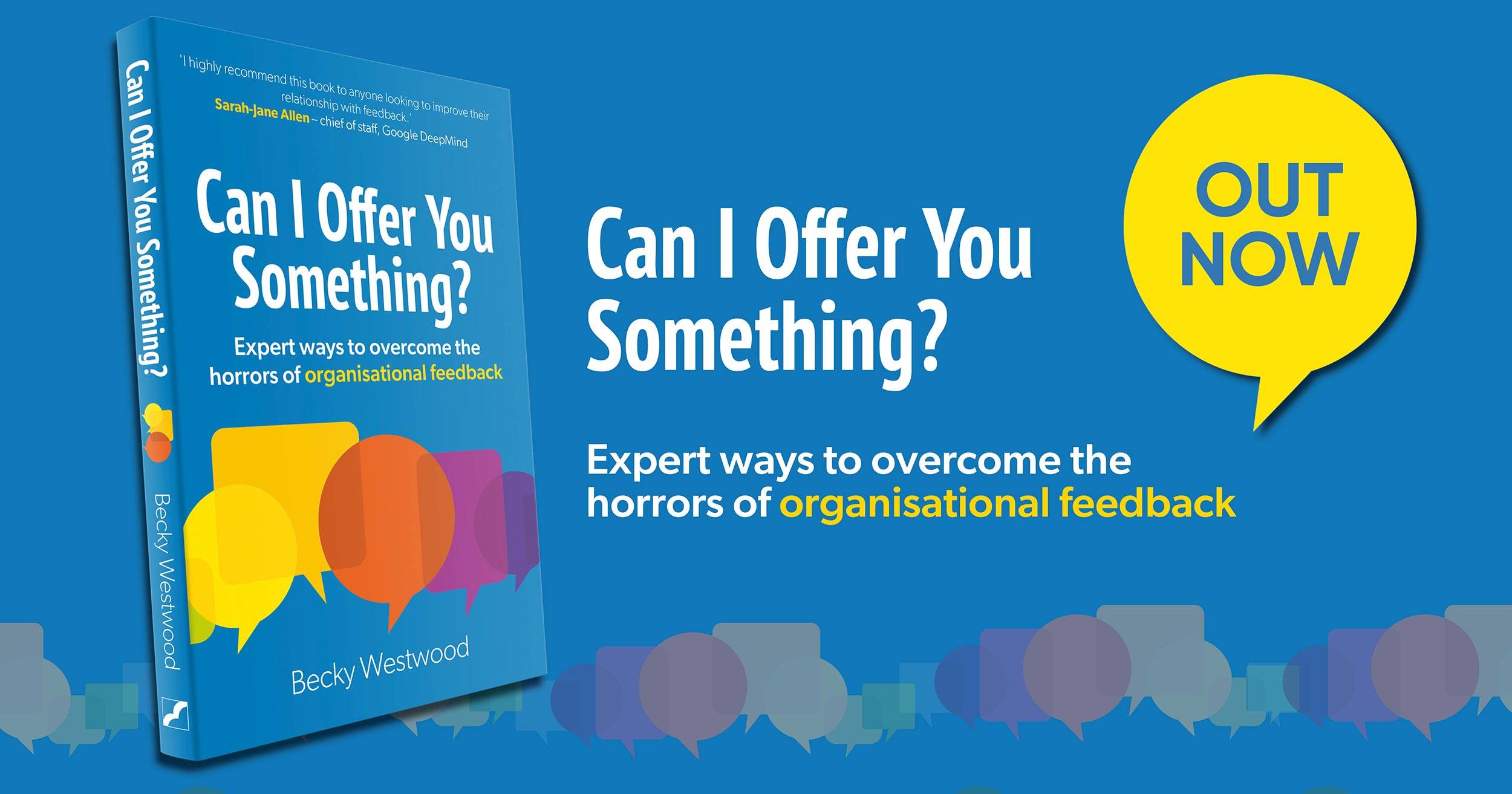

Has your organisation invested time, energy and money into creating feedback processes – and yet they seem to miss what feedback really is – two humans sharing perspectives? Or does feedback feel one-sided, being ‘done’ by one person to the other? This can often create anxiety for both those who give and receive it.
In my experience, too much feedback happens like this. Wasting the opportunity to be so much more beneficial and enjoyable for both parties. Thankfully, there is a better way. To make feedback more productive, purposeful and human, we need to change our relationship with it – and that’s why I wrote my book, ‘Can I Offer You Something?’
This article looks at why exchanging feedback often lacks the human touch – and what we can do to make those conversations less stressful, and more relational.
Feedback is more than a process
When we talk about feedback, we often follow it with the word ‘process’. Processes are great for being able to provide standards, structure and reporting, but when it comes to feedback, they can become so over-engineered that they prevent the thing they were put in place to achieve, which is simply to help people talk to each other.
What’s more, organisations often focus their L&D efforts on the people providing feedback. This typically means managers and leaders getting trained first. Sharing feedback is rarely a solo pursuit and shouldn’t be that one-way ‘generic’ experience. Feedback is a two-way street, a conversation that begins with two humans saying hello to one another.
The downside of models and mnemonics
Another threat to the humanness of feedback are the models and mnemonics often used. Often meant to give structure, they can add to the feeling of process. If you are in L&D you’ll be familiar with the ‘feedback sandwich’ of putting criticism between two compliments, or the structure within the Situation, Behaviour, Impact (SBI) model. Then there’s the anonymous 360-degree feedback and plethora of mnemonics – such as the ‘Three C’s or ‘Five R’s’ of giving or receiving feedback.
There are many more but the point is, there’s no one size fits all approach. But there will be things that may work better for you – or, the person you are sharing your perspective with. That’s why it’s always helpful to ask them what their preferences are. And that in itself is a step towards a more human exchange and that vital two-way street.
What my research told me
When carrying out my own research for ‘Can I Offer You Something?’, 82 per cent of respondents wanted feedback to be relational. Most people want to move away from the one-sided experiences and move the feedback conversation from monologue to dialogue – a conversation where people first understand the human in front of them. In order to deliver this, organisations need to recognise some of the myths surrounding feedback and move away from them.
Making feedback more human – some tips
In ‘Can I Offer You Something?’ I discuss a number of these feedback myths. The belief that feedback is a one-way street, the danger of the one size fits approach, or even the belief that asking questions is a sign of defensiveness.
The answer in preventing these myths being self-perpetuating, is to challenge them with actions that bring the human element back in.
1: Make feedback a conversation. Rather than being ‘done to’. This makes it a two-way street, an opportunity to share points of view and listen openly. When feedback is offered with empathy, people will be more likely to stay present and engaged in the exchange.
2: Ask people what they want. Imagine how differently your feedback conversations would go if two people could walk into a room and start by saying ‘I’m feeling a little nervous about this and what would help me is… There’s no universal formula to do this though. Find the right way for you – and the person receiving it by asking. Be authentic and genuine in the delivery of feedback. Understand how that person best learns and receives feedback.
3: Encourage clarity. No one likes uncertainty but that’s exactly what happens when people feel they can’t ask the questions they want – or that if they do, they’ll be perceived as ‘difficult’ in some way. When it comes to feedback, the clearer you can be about the perspectives being shared will decrease the likelihood of unhelpful meaning-making.
In conclusion
Feedback isn’t something you give or receive in a vacuum. Each different combination of provider and recipient brings together a unique set of individual preferences. To make feedback more human, more purposeful and a true exchange of perspectives, we need to understand these preferences. That’s how the most rewarding feedback conversations are built.
Discover ‘Can I Offer You Something?’
‘Can I Offer You Something?’ is published on September 19th. It’s all about overcoming the horrors of organisational feedback. You can order your copy from the publisher’s website here. Have Amazon Prime? Order from Amazon UK here.