

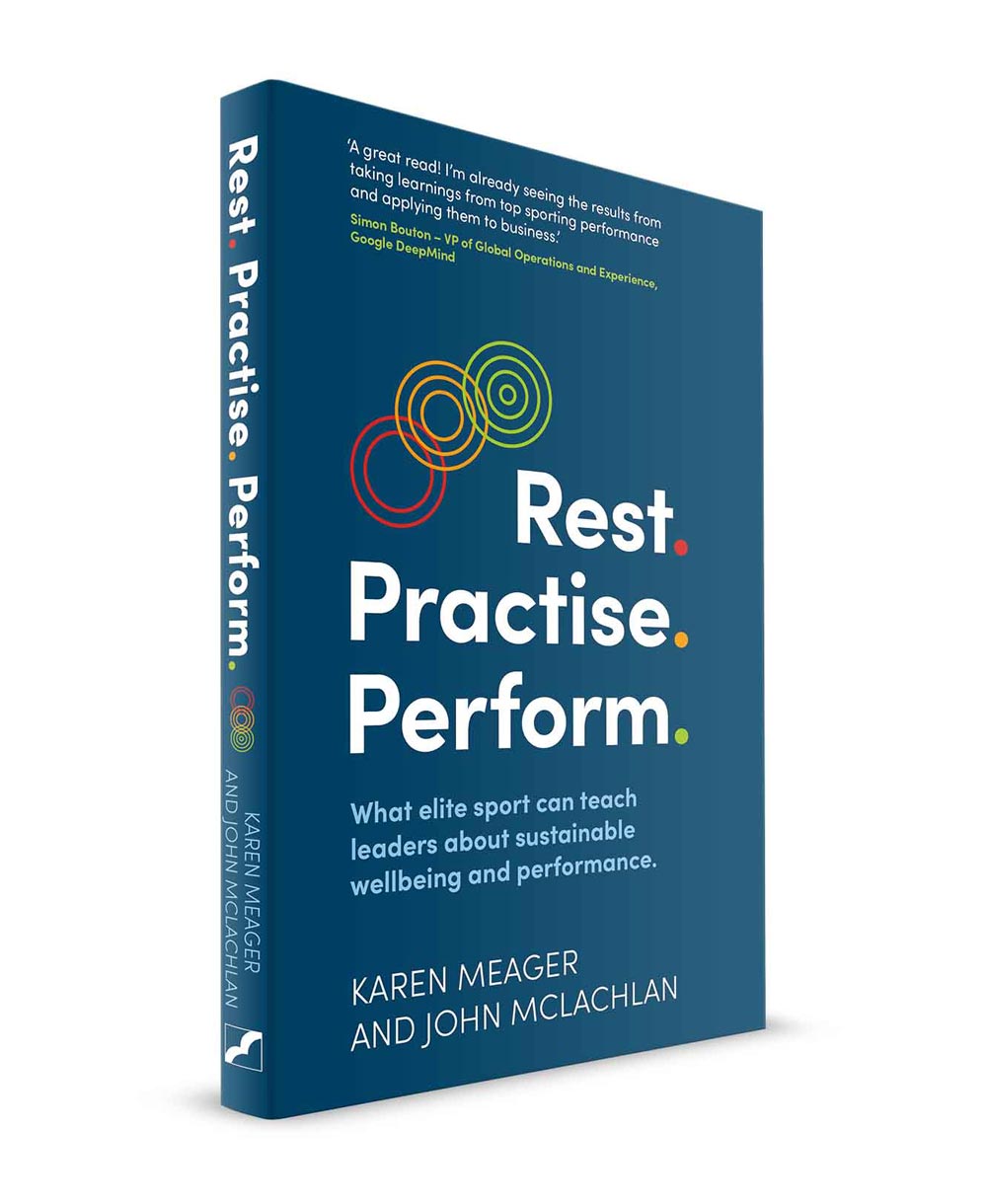
 In their latest book, ‘Rest. Practise. Perform.’ Monkey Puzzle Co-founders Karen Meager and John McLachlan explore how elite sportspeople and their teams manifest sustainable performance – and what leaders and organisations can learn from their strategies.
As they discovered, the answer isn’t to work harder or faster. The secret is to recognise that achieving high performance is reliant on people who need rest, recovery and practise. This is something elite sports and teams do very well – and with clear benefits to health and wellbeing.
In this article, Karen and John talk about what drew them to study elite sports, how that inspired the ‘Rest. Practise. Perform.’ title and what leaders and organisations can learn from the book.
Who is the book for?
The book is written for people that are either leaders in organisations, or who might own their own organisation. They’ll want to find a sustainable rhythm that will actually get them better performance, but also will enable them and their staff to be healthy.
Why is it called ‘Rest. Practise. Perform.’?
As John explains, there’s a powerful deliverable wrapped up in the title. “We named it ‘Rest. Practise. Perform.’ and in that order deliberately. That’s because the end goal is all about performance. There’s a lot of talk in organisations about performing and while this is hugely important, to be able to perform at your best, you need to be able to understand how to rest well and practise well. And this book talks about how to do all three with the clear goal of making sure that you can perform sustainably. We believe that you can, your team can, your organisation can.”
What drew you to elite sports?
A lot has been written about performance in organisations over the years, but how useful has it really been? Does it actually help organisations and their people achieve enhanced performance and in a way that is sustainable? As Karen and John looked to discover new approaches to performance they both, in separate ways, were drawn towards elite sports.
Karen describes what took them there. “My initial research was in how people could recover from burnout and then not go back. And, separately, John was really interested in organisational performance, but finding a lot of the material he was reading about organisations wasn’t really helpful. But where you could find quite a lot of literature was in sport. Sports is a good exemplar for how to avoid burnout but also deliver consistent performance. For example, sports people and teams know that in order to perform at their best there follows a pattern of rest, recharge and recovery to improve their own resilience. To them, rest isn’t about stopping, it’s about resting the thing or ‘muscles’ they use to perform. This is something we believe can be replicated in organisations.”
Which sports did you study?
Both Karen and John are sports enthusiasts with Wimbledon and Formula 1 already in their calendars for 2024. They’ve also been impressed with the more empathetic coaching approach of England Manager, Gareth Southgate. These are all very different sports but all feature elite performers who have to be at the top of their game.
As Karen explains, when it came to the book, they wanted to study a variety of sports disciplines. “We chose three different sports, tennis, football and Formula 1, because they’re very different. They use their teams in very different ways. But, actually, we found they have a very similar rhythm, which is that they have rest periods, they have intense practice periods where they’re practicing the skill, and then the performance is the match, the race. So there’s a very clear performance area. And so the research that we did was really looking into what they did in order to sustain that.”
Do you have to be into sport to enjoy the book?
No! It’s a book inspired by our academic research into elite sports but, as John explains, you don’t need to be into sports to see how you can use the strategies they share. “We use elite sport as an analogy for how organisations can perform. And if you’re sitting there going, “I don’t know anything about sport. I don’t like much sport,” that’s fine too. It’s not really about the sport itself, it’s what you can learn from it. We do the work of actually explaining how sport does something so that you can then apply it to your own organisation or yourself.”
What are the key takeaways?
Going back to the order of ‘Rest. Practise. Perform.’ it’s the first two that will enable improvements in the third, as John covers. “I think the key takeaways will be about how to really start to focus on performance. Really start to think about it as a goal in and of itself, not just ‘work harder, do more’. Both leaders and organisations will start to think about what they are trying to perform at and for. And then the rest and practice elements of it will help them to start to think, “What do I need to do to allow me to be in the best place for that performance? What rest do I need? What do I need to actually do?” So we give you lots of hints and tips as to where your organisation needs to focus, and where you need to focus for yourself.”
It’s all about taking the strategies of how elite sports perform and adopting them in a way that works for them. To this end, John has high hopes. “I expect the leaders who have read this book to actually perform better, more easily, more efficiently. And they’ll have some practical examples of what they can do from it. That’s definitely the goal of the book.”
And, as Karen adds, there’s a wellbeing element running through all of this. “We hope that organisations will realise, as we do, that the people who need to perform are human, they can’t be expected to be ‘on’ 24/7. It may challenge some, but if they want to realise better and more sustainable performance, there’s a strategy behind it. Elite sports recognise this and have proven that well rested people perform better. We believe that those organisations that prioritise employee wellbeing in the same way will see the performance benefits.”
Get the book
Watch the video
If you’d like to find out more about what elite sport can teach leaders about sustainable wellbeing and performance, there’s a brand new video on the Monkey Puzzle website and YouTube here: