
Are you a leader who wants a high performing team? Perhaps you’ve started the year wanting to bring some fresh momentum to the way things are done. You know your people work hard, but if you could focus them on the really important objectives, you’d all achieve so much more. It sounds simple, but pointless work can stop your team performing as well as they could.
This article is all about achieving better performance. We share some of the ideas from our forthcoming book, ‘Rest. Practise. Perform.’ It’s based on what we’ve learnt from elite sports – a world that is built on strategies for sustaining peak performance. And they do it without causing burnout or exhaustion. They’ve found that balance between managing employee wellbeing and delivering results – and we know this is something many leaders can struggle with.
Are you working on the right things?
Let’s start by looking at what takes up your time, and that of your team. Do you ever wonder whether the work you are doing really matters? We’ve observed that in many organisations, people work hard but are not always working on the right things. There can be many reasons for this: lack of clarity around goals, overly ambiguous roles and personal agendas and ambitions to name but a few. Making sure that people are able to thrive and perform involves helping them decipher how much value their work is adding in the overall scheme of things.
How to focus on what makes a difference
If you watch any organisation closely, you’ll be amazed at how much that goes on is seemingly pointless busy work that doesn’t seem to take anyone anywhere. This can happen out of habit, a lack of questioning ‘why’ things are the way they are, an over acceptance of the status quo and some personal style preferences for over complicating things. Combined with the usual communication issues and people problems, this can result in a lot of head scratching for leaders.
So, how can you support your team to drop the busy, pointless work and focus on work that makes a difference? It is not easy but it’s well worth it. People who can see tangible results and feel like they are making progress are more intrinsically motivated, better engaged and happier in their work.
Here are a few ways to weed out unproductive work and focus the team on performance:
Define a ‘performance window’: This is the period of time when someone works in an intense and focused way to achieve maximum results. Elite sportspeople don’t expect to perform 24/7. They and their teams design a rhythm to ensure maximum performance in their performance window. Rest and practice are at the heart of this rhythm. Think about this for each role in your team. You’ll want to be clear about their performance areas and why their work is so important to the organisation. When their focus is on how to perform and when, this will help them work out what matters and what doesn’t.
Ask how work links to the overall objectives: In elite sports, everyone has an objective, whether they compete as a team or an individual. If something doesn’t contribute to this objective, they don’t do it. Get into the habit of explaining and asking how the work people are doing links to the overall objectives of the organisation. If you create this habit, people are more likely to integrate it into their critical thinking, which means they will question themselves or others before saying yes to something.
Be aware of distractions: There is no room for distractions in elite sports. It’s a well-used term but there’s no time to drop the ball. It’s why so much attention is given to activities that require optimum focus. But in organisations people have a tendency to get distracted by pet projects, other peoples’ priorities and favourite work. And if people are tired or stressed, they are more likely to get distracted by these things. That’s not to say there is no room for this type of work, but it should be intentional rather than a default. If you have defined a performance window you can guide people back to their area of focus more easily.
Change perceptions towards rest and practise: People perform best when they have sufficient rest and practise. So, remember to include space for this, it’s central to the ‘Rest. Practise. Perform.’ approach that works in elite sports. Don’t let anyone label these activities as pointless as they are in fact essential. If someone is training themselves on a critical skill or in a rest phase that’s a good thing. If you are noticing heroic efforts and long hours channeling into the wrong things though, this might be the time to step in a course correct.
In conclusion
Despite their best intentions, busy people aren’t always more productive. There’s no correlation between the two. The secret to better performance lies in eliminating activities that aren’t needed, and getting better at those that are. This is the ethos in elite sports. They have fine-tuned what they do to create winning techniques. We believe you can apply some of these approaches to revolutionise your team’s productivity and performance while ensuring your people are better rested for those times when they really need to get results.
About the book
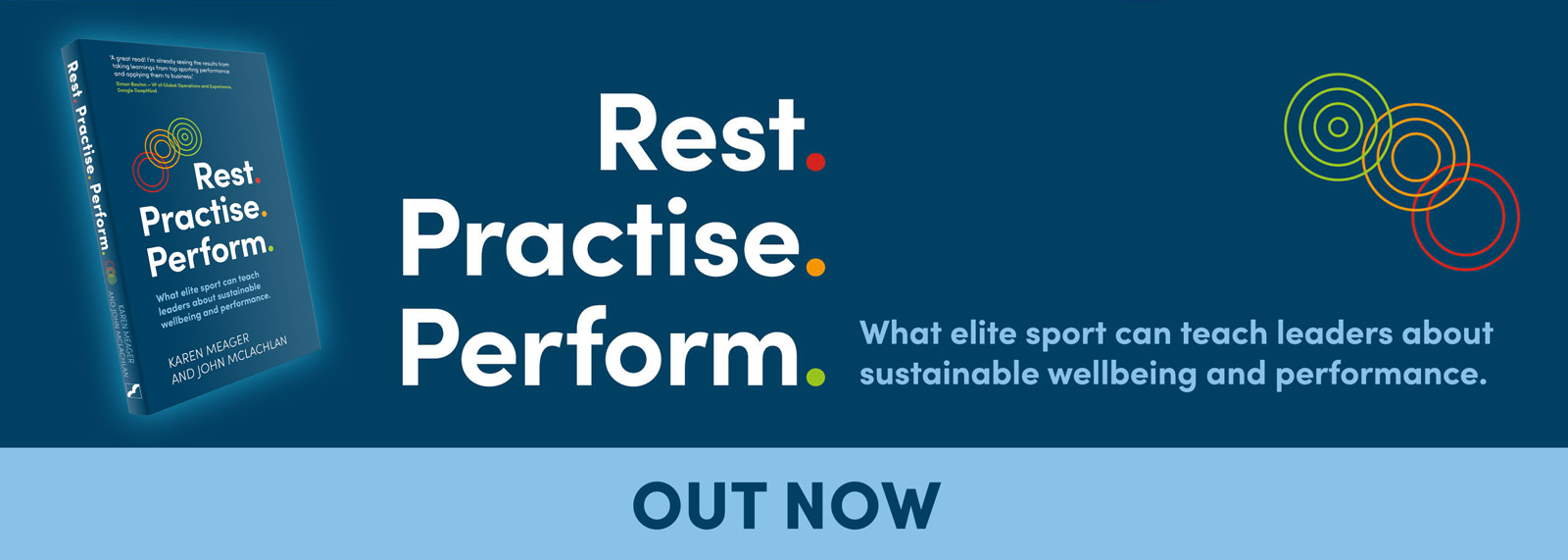
‘Rest. Practise. Perform.’ can teach you valuable tips on sustainable wellbeing and performance, based on the strategies used in elite sports. In their new book, Karen Meager and John McLachlan draw from extensive research and their deep understanding of leadership behaviours to provide you with a playbook for adopting elite sports’ winning techniques.
Out Now: ‘Rest. Practise. Perform.’
‘Rest. Practise. Perform.’ can teach you valuable tips on sustainable wellbeing and performance, based on the strategies used in elite sports. In their new book, Karen Meager and John McLachlan draw from extensive research and their deep understanding of leadership behaviours to provide you with a playbook for adopting elite sports’ winning techniques.