
For your organisation to be successful, your people need to perform at their best. And yet many employees are on a slippery slope to exhaustion, with burnout at record levels.
As many of us strive to do our best to deliver, the problems begin when we don’t allow ourselves the opportunity to rest. This isn’t helped by an increasingly ‘always on’ world where the boundaries between work and life are becoming more blurred. The good news is that there are ways to find a rhythm that supports our wellbeing and better performance. And it doesn’t mean coming to a complete stop.
Drawing on some examples from the world of elite sports and previewing some of the content in our book, ‘Rest. Practise. Perform’, we look at how to design the right type of rest into your working patterns and share some tips to achieve it.
What does performance really mean anyway?
Often, organisational focus tends to be on 100 per cent performance, where success means everyone must be in maximum performance mode every hour of the working day. We understand the need to be productive and recognise why this hangs over leaders, but it’s not a realistic way to work, even if the intention to deliver is nearly always well intended.
Research for our book took us in search of a definition for organisational performance – and left us without any clarity. There’s really no clear answer for what it looks like in the work context. Leaders might have a good sense of what they need or are looking to see – but often struggle with how to achieve it. Employees are trying to prove their worth but are often working ineffectively without any clear direction, which makes the pressure even greater. What we do know, and we can cite the example of elite sports performance here, is that well rested people do perform better.
The cost of tiredness
If well rested people perform better, then there is surely a consequence when rest doesn’t happen and tiredness kicks in. Tired people think less clearly and make poorer quality decisions. They struggle to remain emotionally regulated, which is the ability to experience emotions proportionately. This reduced emotional regulation impedes their ability to communicate appropriately, leading to increased confusion and reduced trust. It’s no surprise that burnout is a global issue. Many countries are currently looking at an exhausted, demotivated workforce.
Rest and burnout prevention
Burnout is the most prominent and most frequently identified consequence of a lack of conscious rest in the world of work. Building rest phases into the organisation goes beyond being kind to your employees; it’s a key component of business success and has a significant impact on business profitability. But it’s also very hard to achieve. It’s well documented that those experiencing burnout experience a denial phase. If they can’t acknowledge it, they may also not realise the need for rest. Likewise, with endless deadlines and delivery pressures, it can be hard to prioritise rest.
To find a solution to counter the causes of tiredness and burnout, we suggest looking beyond organisations to a world where wellbeing and performance go hand in hand: the world of elite sport.
Learning from elite sports
Elite sportspeople and their teams believe in sustainable performance, perhaps doing a better job than organisations in recognising that achieving high performance is reliant on people who need rest and recovery. This approach gave us the title of our book ‘Rest. Practise. Perform.’ In organisations, rest is typically seen as coming to a complete stop, or taking time off for holidays. But in elite sports they design the right type of rest to suit their season or schedule, but often remain highly active.
For example, a lot of footballers play golf in their off season. F1 teams all have a 14-day break over the summer, partly to give teams much needed time to rest and recuperate from the punishing racing schedule. Sports people and teams know that in order to perform at their best there follows a pattern of rest, recharge and recovery to improve their own resilience. To them, rest isn’t about stopping, it’s about resting the thing or ‘muscles’ they use to perform. This is something we believe can be replicated in organisations.
Our tips to find rest
While stress and tension build up in our bodies unconsciously, rest is a conscious activity. To make the most of it, we believe rest needs to be deliberate, planned and thought through to benefit performance. It’s about doing something different, changing the activity you or your team are engaged in and recharging so that in future you can perform in a sustainable way.
Here are some examples you might be able to use in your work or organisation:
- If someone normally has many spinning plates, focus on one or two things for a period of time. This ‘rests’ the part of your brain that has to track many things.
- If someone has a lot of people management responsibilities, hand these over to a second in command for a period of time whilst they focus on a project they are interested in.
- If you work in a service or caring industry, you may need emotional rest from people or intense situations.
- If someone has done a lot of intense, thinking work – go to a conference or work on a collaborative project.
- As a leader, help your team manage their time boundaries – and include yourself here too. Not everyone can manage their own time well for many of the reasons we’ve covered in this article.
- And finally, a universal tip for everyone. Try to switch off from the technology you use at work. It puts you in a work mode outside of work and the glare of blue screen light inhibits restful sleep patterns.
Conclusion
Returning to our premise that well rested people perform better, those organisations that prioritise employee wellbeing will see the performance benefits. Despite the tech in our workplaces, performance still comes from humans – and we all still need rest even if the connected world would have us think differently. Using the examples of elite sports people and teams, rest doesn’t have to mean a complete stop but, for the performance advantages to be realised, rest needs to be built into working patterns.
Out Now: ‘Rest. Practise. Perform.’
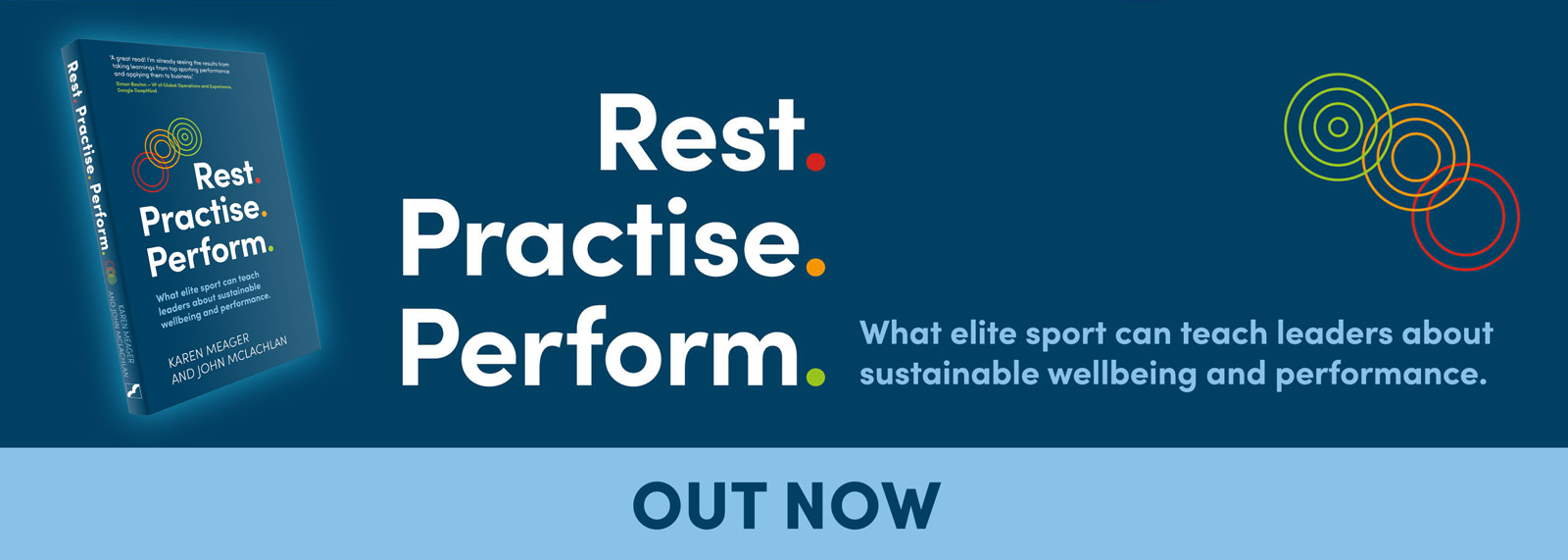
‘Rest. Practise. Perform.’ can teach you valuable tips on sustainable wellbeing and performance, based on the strategies used in elite sports. In their new book, Karen Meager and John McLachlan draw from extensive research and their deep understanding of leadership behaviours to provide you with a playbook for adopting elite sports’ winning techniques.