

Are you working in an organisation with a culture that expects 100% performance? Where delivery is seen as everything – often at the expense of quality, results and employee wellbeing? We think there’s a better way to achieve improved and sustainable performance. To perform better you need to focus on what you perform at – and that means practise.
We’ve long sought to define what good performance in organisations looks like – and found definitions to be less than concrete. In some ways this lack of definition has created the damaging ‘100% on’ obsession. So, we looked towards the world of elite sports. After all, they know all about winning strategies. That’s where we noticed how much focus is paid towards practise which is a cornerstone of our new book, ‘Rest. Practise. Perform.’
This article is about how to achieve better performance by following the same practise strategies that elite sports use. But first, why does practise matter so much?
What elite sports understand about performance
As elite sports professionals know, performing all the time is counter productive when it comes to sustainable performance. If you want quality results over time, with minimal mistakes and problems, you need to build skills and leave space for experimentation outside of when it’s essential to perform.
For example, a professional tennis player will practise for 4-5 hours a day, 5 days a week. This is a lot of practise for a match that only lasts around an hour and a half. But this is common in elite professional sports, people practise more than they actually perform. It is interesting to note then, that in organisations the ratio of practise to performance is much much lower, in some cases it’s practically non existent!
And what organisations get wrong…
It appears to be the norm that organisations hire talented people and then expect them to perform straight away, with just some cursory onboarding. Similarly, when a new team is formed or a project started, the group spends very little time in what we call ‘the practise phase’. That’s building up team ways of working, skills building and experimenting and exploring so that they can perform when needed.
To find a better way to perform, here are some ways you can build more practise into your working rhythm:
1. Practise skills that are slightly outside of your core skill
Sports people use mental coaches, and work on their general fitness, not just their specific technical skill. This is to build up their ability to be the best when they are performing. There is no point in having the best serve in the world if you are unable to handle pressure well. Many organisations we work with have people with highly sought after technical abilities, but the thing that makes these people really exceptional is when they can be ‘good enough’ at skills outside of their technical expertise.
For example, a technical person who can also communicate their ideas well, or manage people, or think creatively, will always outperform someone who is only a deep level expert in their field. So what counts as general fitness for your role? This could be leadership skills, the ability to work under pressure, being able to collaborate well, prioritise or make decisions. Make it a priority to broaden your skills just a bit, it will put you at an advantage over others.
2. Integrate dedicated training time with on the job training
Sports people practise ‘drills’ – doing the same skill over and over until they’ve got it, but they still need to integrate it into their overall game. Training programmes in organisations are the equivalent of these drills. Think about how you are going to support people to build these into their work ongoing. Some organisations use coaching to enable leaders to embed their leadership skills or use real business problems in training programmes to help bring together the skills and the context in which they will be used.
3. Design a Rest. Practise. Perform. rhythm
After an intense period of performing, sports people usually undertake a rest phase, followed by a phase of practise, which gets more focused as they move towards their next performance phase. Can you develop a rhythm that works for you in your work? For example, can you plan holidays straight after busy periods, followed by some kind of ‘downtime’ in terms of type of work, then start building your skills ready for the next period of performance. If your performance window is regular, can you organise your week or day around it? It’s not all about big projects or long time horizons.
In conclusion
Organisations may never be the best at practising, especially when compared to elite sports professionals where it is built into their working rhythm. However, just a little bit more focused practice time will pay huge dividends in terms of the quality of your output and the minimisation of time wasting problems and rework.
Further reading
If you’ve found this article on practise helpful, you will find similar inspiration from our take on the importance of rest and our tips to help achieve it. Take a look at ‘Why well-rested people enjoy better performance’ on the Monkey Puzzle blog.
Discover ‘Rest. Practise. Perform.’
In ‘Rest. Practise. Perform.’ Karen and John draw from extensive research and their deep understanding of leadership behaviours to provide you with a playbook for adopting elite sports’ winning techniques.
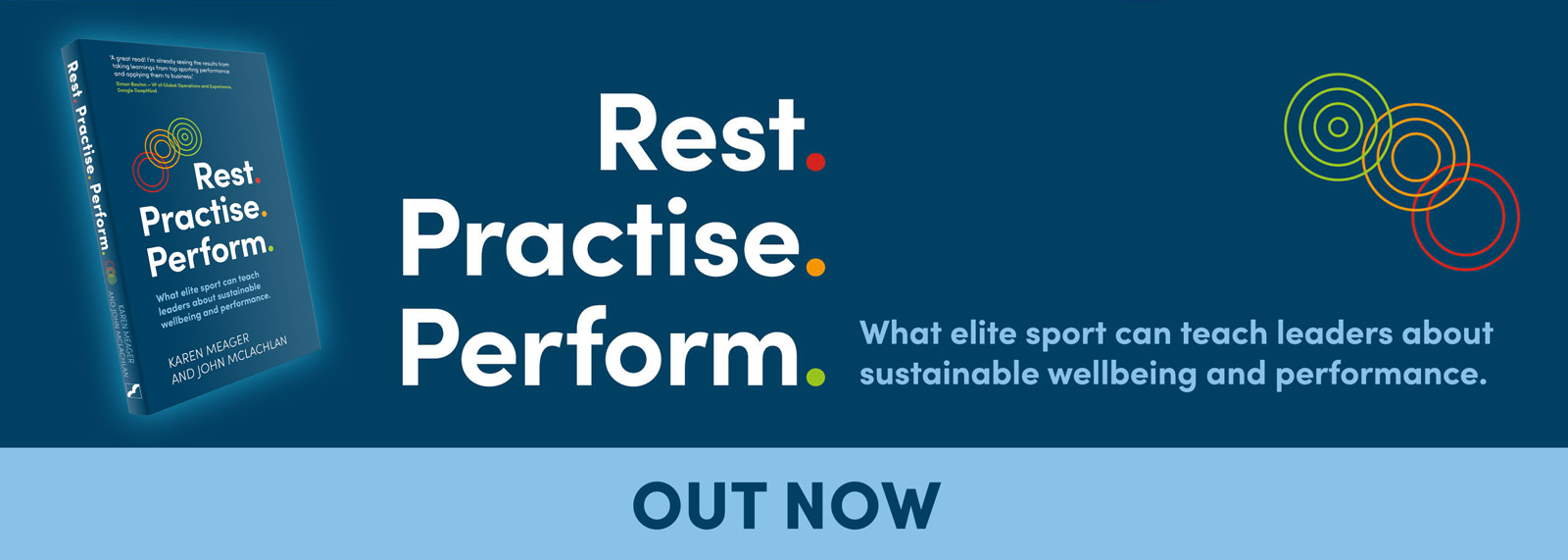
The book is available on Amazon:
Buy on Amazon