
Learning from the elite sports’ approach to practise
This is the second in our Q&A series with performance coach Jon Cooper who shares his perspective on the themes in our book, ‘Rest. Practise. Perform.’. As coach to Paralympian Gold medallist Aaron Phipps, Jon knows all about performance and winning at the highest level.
Part one was ‘Why organisations need to rest’ and in this article we move onto the importance of practise.
Why organisations struggle with practise
In our view, organisations traditionally struggle with the practise phase, often expecting people to perform after just a few short pieces of training and some cursory onboarding. As Jon will explain, in elite sports it’s all about the quality of the practise in the build up to that key performance. If you want to prepare to win, it’s an approach that can’t be compromised.
The premise of ‘Rest. Practise. Perform.’ is that organisations can learn from elite sports’ approach to each phase. So, what does Jon have to say?
In the book Karen and John suggest that organisations don’t practise enough. How could organisations do it better?
In sports, low quality practise leads to low retention, low yield, low improvement and that’s perhaps the same danger when organisations neglect it. When there isn’t the focus on the practise stage that’s what can happen. In sport, athletes can practise for weeks and months to prepare for competition, however it doesn’t mean it needs to take the same amount of time in organisations. It’s about ultra-high-quality practise, not high volume. If they create shorter high-quality moments, they are more likely to increase the retention of what they’ve learnt and turn that cognitive investment into a skill. So, my advice would be to put in that one or two hours to develop a skill, then allow someone to refine that skill in their own way. If organisations want their people to get better at what they do, they have to be given the time to learn something new, improve what they can already do, or to consider a new way to correct an error.
Can you contrast practise in elite sports with the approach taken in organisations?
In elite performance sport, you’re usually practising five days a week for a 90-minute competition. Training might be on a 10 to 1 ratio; for every hour you compete, you practise for 10. It’s not just about constant improvement, but maintenance, recovery, refinement. You might need to learn something new; you might need to refine a skill you already have. You might need to address errors that are occurring and figure out some new strategies. In elite sport the need is a lot clearer when the difference is win or lose, or when the response is “you didn’t score enough”, then it’s obvious to say, “well I need to go work on it.” But these are often the same challenges within organisations. They have performance objectives, KPIs to meet but if you are presenting for example, or you’re told “you need to work on your communication skills”, these things are not as tangible to work on as a physical performance.
Line managers are often the ones who see where skills need to improve. How can they make sure the right practise happens?
It’s about getting better at following through on the things their people actually need to improve on. For example, a manager might tell a member of their team, “You need to work better with others,” or “You need to be able to express your ideas more clearly” or simply, “You’re not collaborating well enough”. If that’s a recurring thing, then that could be corrected through a form of practise. Or let’s say a team is really good at performing a certain task, but they also know there’s something new they need to learn. The solution is to recognise the need and invest in making that improvement. So rather than just saying, “We need to be better at this, now let’s go compete” it’s about realising that there has to be practise time allocated to allow that new skill to be taken on board. In a similar way, there’s a phrase I hear a lot, “You don’t know what you don’t know.” If your people keep getting told the same piece of performance feedback without a plan to correct it, how will they know how to fix it?
What helps people buy into practise?
It’s really about giving practise a context so people know why they need to do it. One of the best examples in sport is the winning kick of Jonny Wilkinson in the 2003 Rugby World Cup Final. He had a context and purpose for all the hours of practise he put in – and people in organisations need the same context. If it had been “Go practise your drop goals” without context it would have been pretty meaningless. Whereas “In six weeks’ time we could be playing in a World Cup Final and it might come down to a drop goal, we need you to go off and work on those,” the reason to do it is now much clearer and you have a sense of value to what you do, based on that practise. You need a high sense of relatedness to what you are practising. What you are doing and why is just as important as the practise itself. What’s more, people who are invested and understand why they are doing it are more likely to learn it faster.
How can organisations build better practise into their culture?
Again, it doesn’t have to take huge amounts of time, but the quality of the practise is really important. An hour of good practise is going to be more effective than 10 hours without any purpose or focus. It could be something as simple as, we’re going to take a one-hour meeting to work on something new, or we’re going to take a short break out to reflect on these practise sessions, or we’re going to allocate this morning towards refining something we do and make it even better. Taking time to practise means that you’ll more efficiently perform, and hopefully as well, you perform more consistently. So, provide your people with consistent environments where they can refine, learn and develop their skills.
Discover ‘Rest. Practise. Perform.’
In ‘Rest. Practise. Perform.’ Karen and John draw from extensive research and their deep understanding of leadership behaviours to provide you with a playbook for adopting elite sports’ winning techniques.
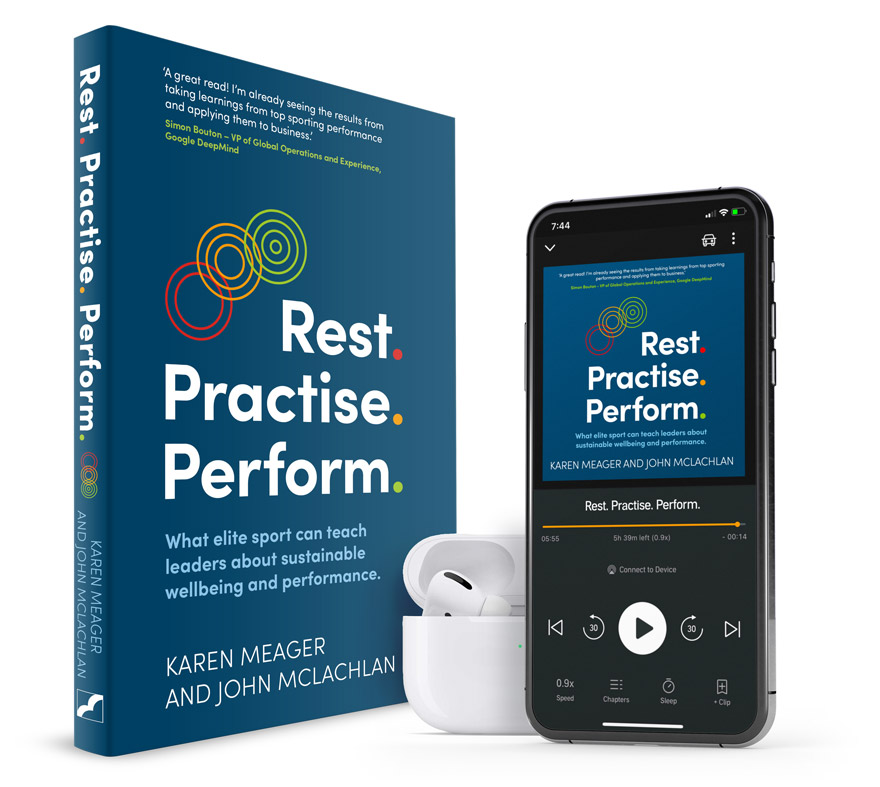
Available to order via Amazon here, and also in audio format, here.
 About Jon Cooper
Discover Jon’s industry and teaching experience, research interests and publications and his work with Solent University, Southampton here.
 About Aaron Phipps
See Aaron’s talk options on his website, from his motivational talk for all “Blood, sweat and wheelchairs”, to Path to Gold delivered alongside Jon. Path to Gold shares the secrets of an elite partnership in the buildup to an unprecedented Paralympic gold medal.