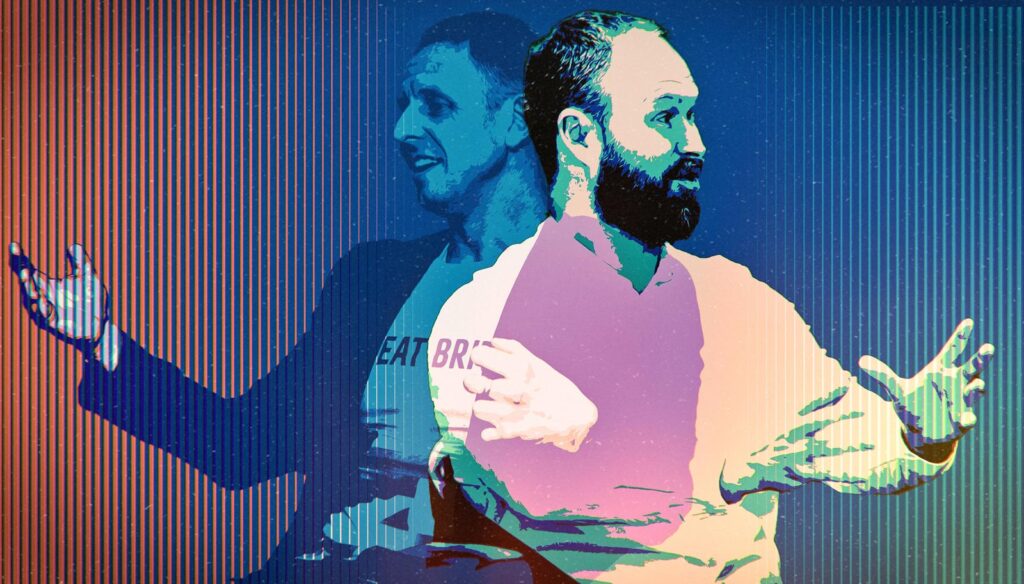
Learning from the elite sports’ approach to performance
This is the third and final article in our Q&A series with performance coach Jon Cooper who shares his perspective on the themes in our book, ‘Rest. Practise. Perform.’. As coach to Paralympian Gold medallist Aaron Phipps, Jon has seen success at the highest level.
Part one was ‘Why organisations need to rest’ and part two ‘Learning from the elite sports’ approach to practise’. In this article we move onto the performance phase, the ultimate outcome in sport. We hope you’ll find these as thought provoking as we did when talking to Jon.
The challenge to define organisational performance
Of course, organisations also need to perform but the challenge comes when they try to define what that looks like. We feel that it’s near impossible to define performance in any meaningful way. What’s more, as organisations are complex, there are differing opinions as to what performance is and what can be expected.
We believe that failure to recognise and embrace the value of rest and practice will hinder the success of the performance phase. This doesn’t happen in elite sports where dedication to rest and practice ensures that athletes are ready to perform at their very best.
That’s why we believe that organisations can learn from elite sports’ approach to the performance phase. Let’s see what Jon has to say…
Talk us through the performance phase from an elite sports perspective. Why do you think organisations struggle to define it?
A performance phase varies across different sports. It could be as large as, “We need to perform over this two-week period because that’s the Olympic or the Paralympic Games” or as small as a one-day event or one crucial game. Everything else is a buildup to a performance phase and there’s a saying that “You can’t win a world championship in the group stage.” You could perform then, but you still have to perform again later. It could also be a pivotal moment in a game, where one player is going to be brought on and that’s their performance window. In this respect, organisations have the same challenges. For them performance is harder to define. It might be there’s no one specific moment that you have to be able to perform at, or performance is a regular thing that might occur every couple of days. First you have to identify it and then you can work to that.
How do rest and practice help prepare for better performance?
For both athletes and organisations, there has to be an understanding that performance isn’t something that’s automatically achievable because of the level of mental, physical and emotional demand it takes to operate at peak performance. It’s very difficult to sustain that for extended periods of time or every single day. There are going to be undulations which is why appreciating the value of rest and the ability to practice are important stages in getting there. To give you an example, an athlete can perform with greater confidence if they’ve overcome a block or a challenge in the practice phase, so that it wouldn’t be an issue for them in the performance phase. This can reduce performance anxiety, because the athlete now knows they are resilient and can cope with the challenge, which helps them to focus on performing.
The book sets out to use examples in elite sport to teach organisations about sustainable wellbeing and performance. What do you see as the component parts to sustainable performance?
Sustainability is the ability to prevent decline. So firstly, the first stage is can you actually perform the task that you are required in order to perform? Let’s say it’s Usain Bolt when it’s a hundred meters; can you physically run faster than the time we might predict for you to be able to win that event? That’s the first thing; is it even doable? Then it’s, can you do it consistently, and then can you do it when it really matters? One is more of a learning phase; another is more of a refinement phase, and another is that performance phase. Can you do it when someone is almost trying to actively stop you from doing it? So that’s the difference between running a world record pace in practice and doing it when there’s someone next to you who wants to beat you.
How would you demonstrate this in an organisational example? What does it take to help them perform when it really matters?
In a work context this might be a crucial meeting with a key client, and you might realise that you know the topic, but what does it take to deliver at the key moment? I’ve worked with a lot of athletes who are very good at one and two, but really struggle when the pressure’s on. And I’ve worked with a number of people who really struggle to learn an idea and to perform it consistently in practice, but when the pressure comes on, they’re very good at just sort of producing it. The secret is in finding out how those people operate and helping them to understand that you are trying to create situations for them to succeed.
When does practice turn into a sustainable performance skill?
Sometimes people will be under pressure and they’ll perform really well but feel like they’ve ‘winged it’. The question is, can they reflect and understand why they performed well? Because if they can, they can now work on achieving success consistently. So if you can consistently put the effort and work in enough that you get it right under pressure, you’re no longer just winging it. Whereas if you go out and have that one magic performance but you can’t replicate it, now you are just winging it and it’s not a well-defined enough skill to be able to perform. There aren’t any short cuts, it takes consistent effort to build a sustainable habit.
How do you prepare for the performance of a team, compared to an individual?
I think with an individual you can focus a lot more time and effort into a very bespoke journey, almost irrelevant of what other people are doing. That almost becomes part of it; can we do something different? A team is a group of individuals of two or more that are going towards the same target. So there is an element of group dynamics that everyone needs to be aligned and pulling in the same direction, which means you’re now dealing with a series of individuals that all need to cooperate and perform together and all need to be able to align to the same agenda. That’s where another layer of practice could come in for organisations around, for example, can we operate well as a group? If you are going to give that presentation as an individual or as a group of four, are you coherent? Are you working together? Do you all understand how what you brought to the table will add to the final message? It is about shared drive and uniformity in delivery. In a sports context you can’t have six people with different playing styles. Everyone needs to adopt a group way of playing. I think that’s part of the challenge of a team, compared to an individual, and teams need to balance a range of strengths.
Discover ‘Rest. Practise. Perform.’
In ‘Rest. Practise. Perform.’ Karen and John draw from extensive research and their deep understanding of leadership behaviours to provide you with a playbook for adopting elite sports’ winning techniques.
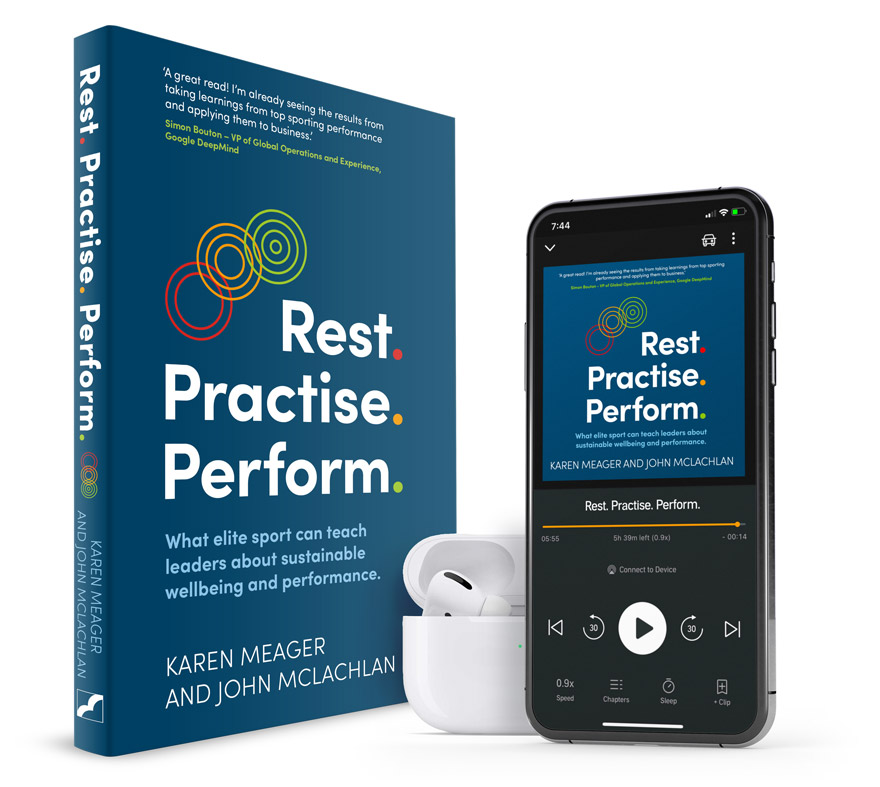
Available to order via Amazon here, and also in audio format, here.
 About Jon Cooper
Discover Jon’s industry and teaching experience, research interests and publications and his work with Solent University, Southampton here.
 About Aaron Phipps
See Aaron’s talk options on his website, from his motivational talk for all “Blood, sweat and wheelchairs”, to Path to Gold delivered alongside Jon. Path to Gold shares the secrets of an elite partnership in the buildup to an unprecedented Paralympic gold medal.